
Wool vs. Synthetic Rugs: The Real Difference
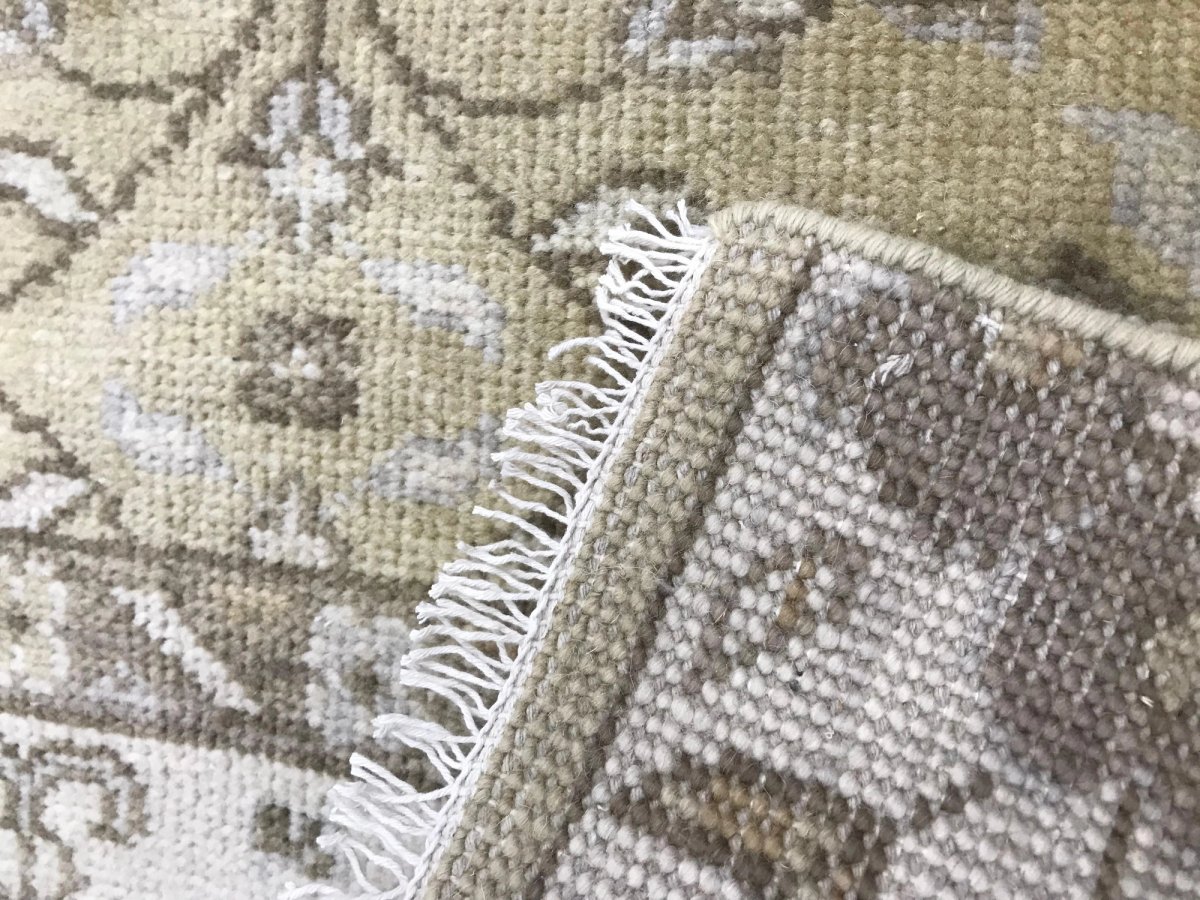
If you've shopped for a rug recently, you've probably noticed the price gap. A wool rug can cost three, five, sometimes ten times what a synthetic one does. It's fair to ask whether that difference actually means anything once the rug is on your floor. It does. Here's what's actually different, fiber by fiber.
What "synthetic" actually means
Most synthetic rugs are made from polypropylene, polyester, or nylon: plastic, essentially, extruded into fine strands and woven or tufted into a backing. It's manufactured to look like wool at a glance, and modern synthetics have gotten good at the impression. But the material itself behaves nothing like wool once it's living in a room.
Polypropylene doesn't absorb moisture, which is why synthetic rugs are marketed as stain-resistant. It also doesn't spring back. Walk the same path across a synthetic rug for a few months and you'll see it: matted fibers that don't lift, a flattened track where the couch legs sit, a slight sheen where the pile has been crushed and stays crushed.
What wool does differently
Wool fiber has a natural crimp, a coil in its structure, that acts almost like a spring. Compress it and it wants to return to shape. That's why a good wool rug can take a chair leg, a dog, a decade of foot traffic, and still look full when you finally get around to moving the furniture around it.
Wool also regulates moisture in a way plastic can't.
Wool fiber can absorb close to a third of its own weight in moisture without feeling damp. That's part of why wool rugs resist mildew and don't hold onto humidity the way you'd expect.
It's the same reason wool sweaters work in both cold and mild weather. The fiber is doing something active, not just sitting there.
Durability, by the numbers
- A well-made wool rug can last 20 to 30 years with reasonable care
- Most synthetic rugs are built for a 5 to 10 year lifespan before the pile visibly breaks down
- Wool's natural crimp resists matting; synthetic fiber compresses and stays flat
That gap changes the math on price more than people expect.
The hand-feel difference
This one is hard to explain until you've touched both. Wool has a slight tooth to it, a texture that comes from the natural scales on each fiber. Synthetic fibers are smooth and uniform because they're extruded, not grown. Underfoot, wool feels warmer immediately. This isn't just perception: wool is a genuinely better insulator, which is part of why hand knotted and hand tufted rugs have been the flooring of choice in cold climates for centuries, long before synthetic alternatives existed at all.
Dye is another giveaway. Wool takes natural and synthetic dyes into the fiber itself, so color reads with depth and slight variation, strand to strand. Synthetic fibers take color more uniformly, which is efficient for manufacturing but can look flat in person, especially in solid colors or subtle gradients.
Where synthetic still makes sense
This isn't a case against synthetic rugs entirely. If you're outfitting a rental you'll leave in a year, furnishing a space on a tight budget, or need something for a high-moisture area like a mudroom, synthetic can be the practical choice. It's lighter, often machine washable, and there's no ethical dilemma in walking away from it when it wears out.
The tradeoff is durability and feel, not function. A synthetic rug will do its job. It won't improve with age the way wool does.
What this means for a hand knotted or hand tufted rug
Every Indo Knots rug is made with wool, sourced for its quality and worked by hand:
- Hand knotted — each strand tied individually around the warp
- Hand tufted — a tufting gun drives yarn through canvas backing, row by row
Both techniques rely on wool's natural resilience to hold their shape and density over years of use. That's not a marketing claim, it's just how the fiber behaves.
If you're deciding between a wool rug and a synthetic one, the real question isn't which looks better in a photo. It's how long you want the rug to look that way, and how it should feel under your feet in the meantime.
Curious which construction is right for your space? Read our guide on Hand Knotted vs. Hand Tufted rugs, or browse our current collection.
Indo Knots
The Indo Knots team is dedicated to documenting traditional weaving techniques, premium wool care, material sourcing, and global trade collaborations directly from our Bhadohi workshops.
Ready to find your perfect piece?
Explore our masterfully woven collections of hand-tufted and hand-knotted organic wool rugs.
Browse Collection